
At a time when conversations around cultural identity, migration, and coexistence are shaping global headlines, from debates on immigration in Europe to conflicts rooted in ethnic and cultural divides across regions, the question of how civilizations meet, clash, and evolve feels more urgent than ever.
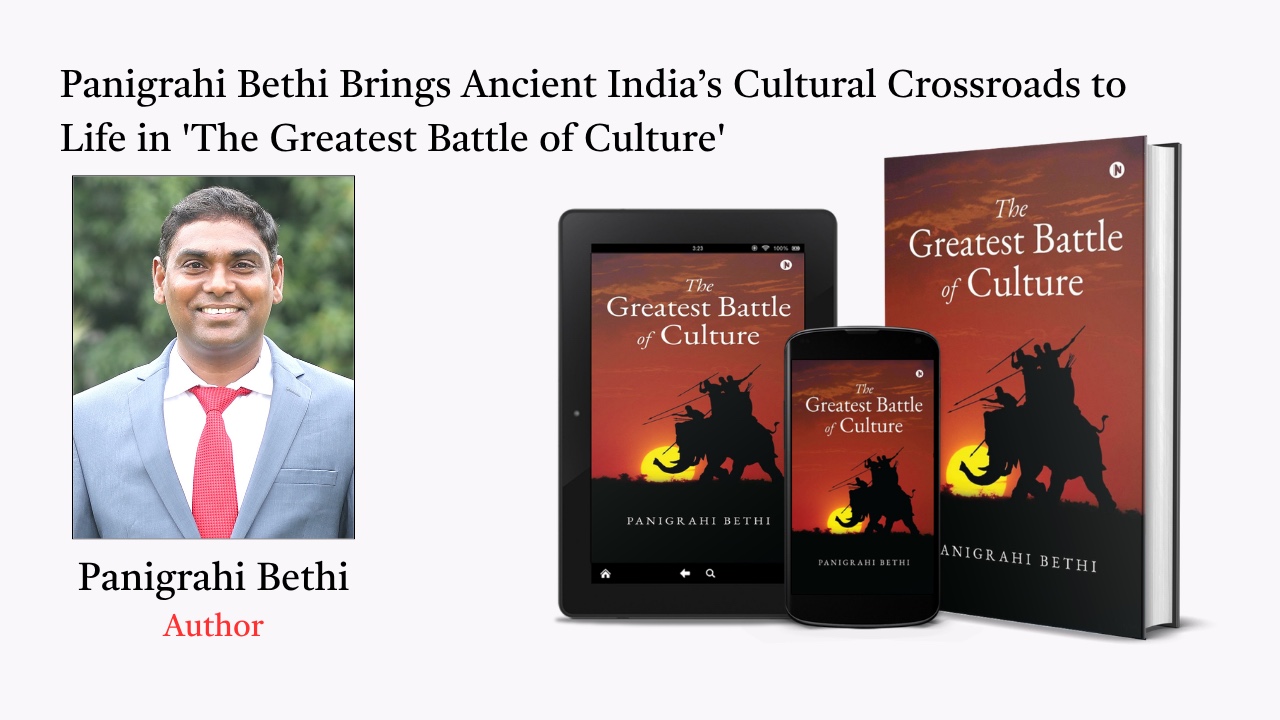
It is within this contemporary context that Panigrahi Bethi’s ‘The Greatest Battle of Culture’ finds striking relevance. The novel reimagines a lesser-explored chapter of ancient India, offering not just a historical narrative, but a lens through which to understand the complexities of cultural interaction.
The book revisits the encounter between the Harappan civilization and the Aryan tradition, not as a one-dimensional conflict, but as a layered story of exchange, resistance, and transformation. It stands out for its distinctive approach to historical fiction, foregrounding human experience over rigid historical binaries.
Reimagining a Civilization Beyond Ruins
In popular imagination, the Harappan civilization often exists as a series of ruins and unanswered questions. Bethi’s narrative challenges this distance by reconstructing a living, breathing world.
Cities are not just archaeological sites but spaces filled with movement and purpose. Systems are not merely functional but deeply integrated into daily life. Through intricate detail and immersive storytelling, the Harappan civilization emerges as advanced, organized, and remarkably forward-thinking.
Mr Bethi notes, “It isn’t just about two civilizations colliding, but about what happens to people when their worlds intersect, how beliefs are questioned, identities shift, and something entirely new begins to take shape.” In this reimagining, the past is not static, it is dynamic, evolving, and deeply connected to the present.
The Aryan Lens: Arrival and Disruption
Contrasting this structured world is the fluid and mobile nature of the Aryan tradition. Defined by movement, shifting traditions, and a strong warrior ethos, this culture introduces a different pace and perspective.
The novel presents the meeting of these two civilizations not as a simple opposition, but as a complex interaction. Stability encounters motion, structure meets adaptability, and both are transformed in the process.
Importantly, the narrative avoids oversimplification. There are no clear heroes or villains. Instead, both cultures are portrayed with nuance, each shaped by its own strengths, limitations, and internal contradictions.
At the heart of this reimagined history are characters who embody the tensions of their time.
Purusha’s journey reflects the possibility of transformation through understanding. Baguhara represents the responsibility of preserving cultural identity in uncertain times. Armita emerges as a compelling presence, her relationship with Purusha symbolizing the fragile yet meaningful connections that can form between differing worlds.
The philosophical exchanges between Ashwin and Varun further deepen the narrative, turning it into a story not just of events, but of ideas and perspectives.
Why This Story Matters Today
In a world where cultural intersections often lead to conflict, The Greatest Battle of Culture offers a more layered perspective. It suggests that while encounters between civilizations may begin with tension, they also hold the potential for growth and reinvention.
The novel ultimately reminds us that civilizations are not built in isolation. They evolve through interaction, through friction, and through the blending of ideas.
A Story Resurrected
Available worldwide in both paperback and e-book formats, ‘The Greatest Battle of Culture’ invites readers to revisit ancient India through a fresh and humanized lens.
In reimagining an untold story, Panigrahi Bethi offers not just a novel, but a perspective, one that connects the distant past with the realities of the present, and reminds us that history is not just what happened, but how we choose to understand it.
The Hindi edition, Sanskriti Ka Mahasangram, written by Panigrahi Bethi and translated by author and bilingual writer Asha Seth, was launched on 25th March, 2026, further expanding the book’s reach to a worldwide audience.
